Sign up to my weekly newsletter for latest posts & updates!
Plus, I'll send you a free copy of the eBook I wrote on travelling with insulin :)
Thank you for joining the community! :) To receive your free download, you will need to confirm your subscription via the email I have just sent to you. If you can't see this in your inbox, please check your spam folder.If you have any issues, please email me personally at: thatdiabeticgirlblog@gmail.com
Oops! Something went wrong while submitting the form.
The 7 Best Insulin Cooling Cases Available In 2026
Written By:
Cazzy Magennis
Last Updated:
September 7, 2026
Looking for the best insulin cooling case to keep your insulin cool when you need it most? Look no further! We look at the best products available today..
This post may contain affiliate links. If you click and buy through one of these then we may receive a small commission, at no added cost to you (more info here). All information on this website is subject to this disclaimer.
We need insulin to live, simple.
So, it’s very important to ensure that we keep our insulin safe in everyday life.
But thankfully there are ways to counteract this by using insulin cooling cases!
Below I’m going to take you through everything you need to know about insulin cooling cases and about keeping your insulin cold.
What are the different options for keeping insulin cold?
Thankfully we live in a world where innovation is high and that results in a lot of different options when it comes to keeping your insulin cold.
Naturally, the best way to keep our insulin cold is via the fridge, but we don’t always have access to a fridge, especially if we are travelling, out shopping, camping, etc.
So when you don’t have access to a fridge, your next best option is an insulin cooling case!
I’m going to take you through the best insulin cooling cases available on the market today, and show you what my favourite product is for keeping insulin cold.
What is the VIVI Cap: Thermal Insulin Pen Carrying Case?
If you use insulin pens, rather than insulin vials for an insulin pump, then this is the PERFECT product for you.
This innovative product allows you to keep your insulin pen safe whilst on your travels, so it won't overheat or freeze.
Some highlights of the product include:
Works every day for years with no maintenance: This product is an investment into your insulin cooling future. You won't need to replace it, it won't go "moldy", so you can feel confident it will continue to work for you when you need it most.
Built-in temperature sensor with easy to read temperature indicator: This is a very cool feature that will actually let you see the temperature that your insulin is at. This takes away the guessing game, so you can always be sure your insulin is cool when traveling.
Small & lightweight: This product is not going to take up valuable space in a backpack, suitcase or even handbag. It's small enough to fit in your purse, so perfect when you're sightseeing in the city, or heading out for dinner.
No need for water, ice packs, refrigeration or battery charging: a fuss-free product for those with insulin pens!
I am actually in the process of reviewing this product, so I will add even more thoughts soon, but on first impressions, this seems like an excellent product, especially if you're a frequent traveler like myself.
It's perfect for taking your insulin out for the day, say if you're heading to the beach, or even going on a day-hike, day excursion, whatever it may be.
You can pop your insulin in the VIVI Cap and be sure it's going to stay safe!
A great product to add to your diabetes packing list.
2. Svalto Cooler Pro - Best cordless insulin cooler for long-haul flights - Get 15% off with my link!
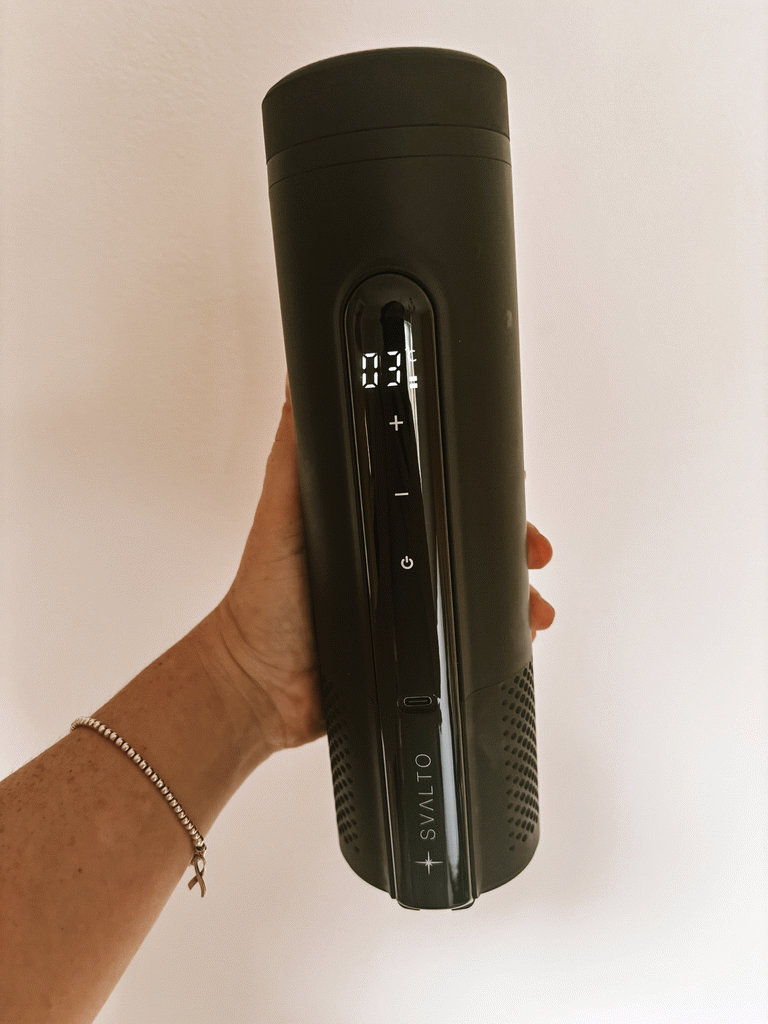
The Svalto Cooler Pro is one of the most advanced insulin cooling cases I’ve tested so far.
Rather than using ice packs, water or an insulated pouch, the Svalto works like a portable mini fridge for your insulin.
It uses active thermoelectric cooling and allows you to choose a target temperature between 0°C and 18°C.
The digital display on the front shows the current temperature inside the chamber, so you can check exactly how cold it is throughout your journey.
The Svalto Cooler Pro can be powered in two different ways:
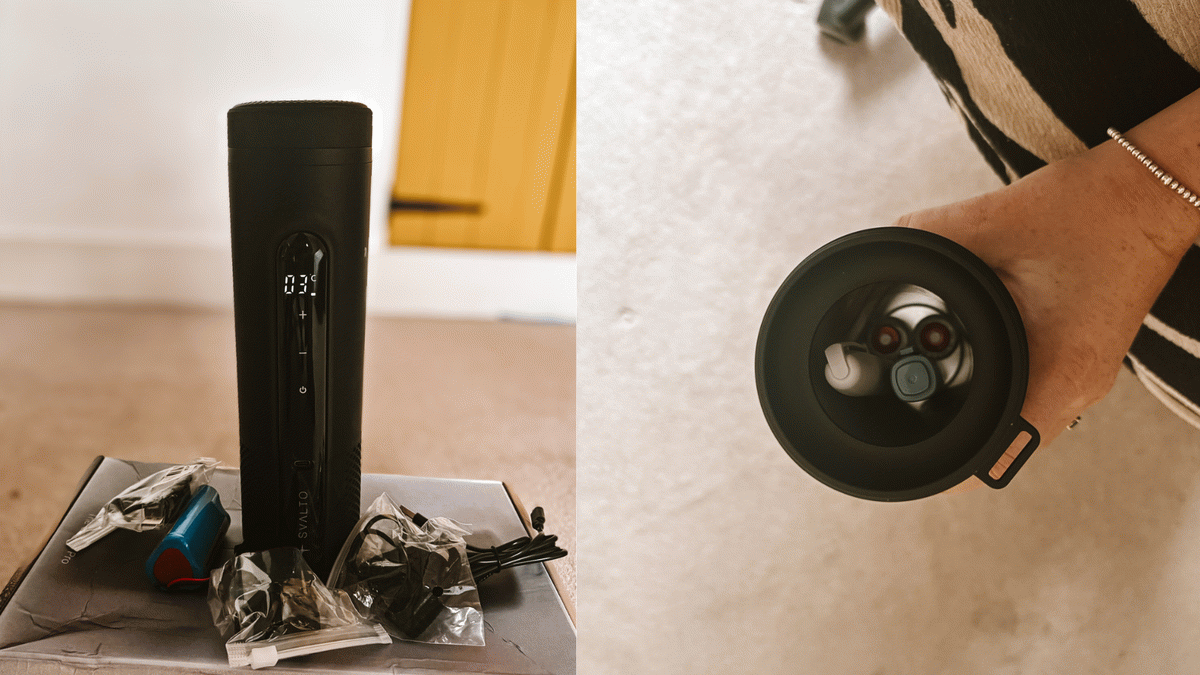
You can run it cordlessly using one of the removable 10,200 mAh Power Cell batteries.
You can remove the battery and power the cooler directly through USB-C using a wall socket, car, laptop or power bank.
Each Power Cell offers a claimed 7 to 9 hours of cordless cooling.
I tested the Long-Haul Kit, which includes two batteries and provides a combined claimed runtime of approximately 14 to 18 hours.
For me, this should cover pretty much any long-haul flight I am likely to take!
You can also purchase additional batteries if you need the cooler to run for even longer.
I was impressed by how quickly it started cooling during my test. The display initially showed approximately 18°C, and within around five minutes it had already dropped to approximately 10°C.
It is also surprisingly quiet. You can hear a very light fan noise when you are close to it, but it is not loud or distracting.
How much insulin fits inside?
Svalto officially states that the Cooler Pro can hold up to five slim insulin pens or five 10 ml insulin vials.
My own testing was broadly in line with this, although I actually managed to fit slightly more.
I comfortably fitted five mixed Humalog and Lantus insulin pens inside. I could squeeze in six, although they were packed quite tightly.
I also managed to fit eight unboxed 10 ml Humalog vials. Again, this was a tight fit, and I would not necessarily recommend carrying that many unprotected glass vials together.
If carrying unboxed insulin vials, I would use silicone vial protectors to stop the glass bottles knocking against each other or the metal interior of the cooler. Just remember that adding protective covers will reduce the overall capacity.
You can also fit two fully boxed 10 ml insulin vials inside.
Another useful option is mixing insulin vials and pens.
I comfortably fitted two 10 ml vials alongside two insulin pens, with enough room to potentially add another vial.
This could be particularly useful for insulin pump users who travel with vials for their pump alongside insulin pens as an emergency backup.
Pros
Actively cools your insulin without requiring ice packs or water
Live temperature display removes much of the guesswork
Removable batteries provide 7 to 9 hours of claimed cordless cooling each
The Long-Haul Kit provides a claimed 14 to 18 hours across two batteries
Can also run continuously from a suitable USB-C power source
Can carry a useful mixture of insulin pens and vials
Cons
It weighs approximately 900 grams before adding your insulin
Battery performance and cooling ability depend on the surrounding temperature
The included shoulder strap could benefit from additional padding
Overall, I think the Svalto Cooler Pro is a brilliant option for anyone who needs to transport a substantial supply of refrigerated insulin.
It is especially useful for long-haul flights, road trips and travel days where you cannot rely on having continuous access to a plug socket or refrigerator.
If you only need to protect one in-use insulin pen for a few hours, this may be more expensive and heavier than you need.
But if you want active cooling, a live temperature display, excellent capacity and the ability to swap batteries during a long journey, the Svalto Cooler Pro is one of the most capable options in this guide.
I’ve been using Frio bags to keep my insulin cool for around 6 years, and I can honestly say, they haven’t failed me yet.
Here is some information about the Frio insulin cooler to help explain what the product is, and what exactly it does.
Frio bags are a unique product which is an evaporation cooling pouch that works by keeping your insulin cold when it’s not in the fridge. It’s simply activated by soaking it in cold water for a predetermined amount of time (it depends on the size of your Frio bag, but instructions are provided)
It keeps your insulin between the temperature of 18-26°C (64.4-78.8°F) for 45 hours minimum, even in a constant environmental temperature of 37.8°C (100°F)
It can be reactivated for subsequent periods of 45 hours minimum for up to 28 days (however I personally have used them much longer than this)
They’re stylish and come in a range of designs and colours
1. Firstly there is the Biogel bottle, which you can refrigerate for 6-8 hours in advance then put it in your cooling case along with your insulin and cover it up!
2. If you've got access to electricity, (even the lighter in your car) you can put the insulin into your vacuum bottle and cover it with the black cooling cap. You then connect it power with the USB (have it on 30 minutes before you put your insulin in).
This combination of two ways to keep your insulin cool while on the go means it will pretty much keep you covered for all situations. Whether you're road tripping in a car or campervan, backpacking Asia, or even just on holiday!
I think that's really cool!
Pros
Can keep your insulin cool up to 72 hours
It's versatile and offers a variety of cooling methods in one product
It can be used with in-car 12V when adapted to a USB so a brilliant option for road trips!
Comes with a 1 year warranty
Cons
They only seem to have it in blue (which is nice, but maybe not for everyone)
Pro tip:Use the code THATDIABETICGIRL to get 10% off your purchase!
BreezyPacks are an awesome company that creates a really unique insulin cooling case.
They work by using a unique chemical absorbs energy when the temperature is hot outside and actively cooling the content of the case (PCM). When the temperature drops, the PCM regenerates by itself.
This basically means can simply pop your insulin inside and it will continuously be protected without a time limit. This is because the case recharges itself every night which I think is really cool!
Quick note, in order to recharge, they need to be at a cooler temperature (24°C/75°F or less) or, if you are short on time then you can put them in the fridge for 1-2 hours.
The product comes in two different forms, the BreezyBasic and BreezyPlus, which are basically the same thing, but differ in the amount of time they can protect your insulin in the heat.
The Basic can protect your insulin on a hot day for up to 6 hours, and the plus for 9!
You can fit 2 insulin pens in both, and probably around 3-4 vials (but I will confirm this when I use my product)
What's also great is that the "plus" model can withstand even extreme climates, surviving entire days in the heat and temperatures of up to 46°C/115°F for shorter durations which is perfect if you're off on an adventure hike, or a day of city sightseeing.
I'll have a full review of the product soon which I'll link to when it's ready, but what I really like from first impressions, is the fact that there is no issues or complications or annoyance with "setting" it up, basically because it doesn't need any.
There's no need to drop it in cold water, like you have to with a Frio bag, or charge it, or even refrigerate it, and that's really cool.
Another great thing is they deliver worldwide which is useful!
I think this looks like a great placed product for day trips with diabetes, trips to the beach, camping trips, hiking adventures, or city breaks.
They're also creating a larger version coming out this fall, which will be able to hold even more insulin which will be a great solution for longer holiday trips AND backpacking adventures.
7. Lekesky - Another great option for shorter trips
This product is another insulin cooling case that makes use of ice packs.
This means I would personally recommend Lekesky for shorter travel days and trips, and generally less stressful situations. Here are the facts:
Keep insulin at 2-8℃ for 6-8 hours. Keep insulin at 25℃ for 48-72 hours
You need to freeze two cooling tablets in the freezer for 6-10 hours beforehand and the insulated panels help keep them cooler for longer periods
It comes with a unique and innovative Temperature Indicator which means the temperature of the insulin can be seen directly without using a thermometer
There is a 1 year warranty with the product for satisfaction
Insulin is a live product that keeps us alive, and in order for it to function well we need to keep it at a certain temperature.
If our insulin is exposed to extreme heat or cold, and fluctuates between these two temperatures, then it can destroy the insulin which will make it no longer suitable for use.
Before you look at ways to keep your insulin cold, you actually need to consider whether it needs to be kept “cold”.
What I mean by this is that if you’re taking your insulin away for a day and you aren’t expecting any crazy temperatures, then your insulin will be completely fine in your diabetic supply bag or purse, whichever you use, rather than an insulin cool pouch.
But, if you’re visiting somewhere very cold, or warm, then it’s best to take extra precautions with an insulin cooling case to help ensure your insulin stays safe.
Insulin can react adversely in cold temperatures. It can easily freeze when exposed to temperatures that it isn’t suitable for.
I once put my insulin in a hotel fridge (or what they told me was a fridge) and it froze my insulin, solid. You cannot use it after it defrosts.
The insulin is dead and needs to be disposed of.
Insulin can also react in warm temperatures. The heat can cause insulin to go cloudy or form clumps, and these are both indications that your insulin has died from exposure to the heat and it should again be disposed of.
What temperature should insulin be unopened?
For unopened insulin, which is still in the box, and hasn’t been used yet, the ideal place for your insulin is in the refrigerator at a temperature of around 2-8 degrees C [ 36-46° F]. If refrigeration is not possible, it can be kept at room temperature [15-25 degrees C] for 28 days.
What temperature should insulin be after opening?
For insulin that’s already been opened and that you are currently using the ideal temperature is 56°F and 80°F (13-26 degrees C).
And the insulin cooling cases we will discuss below will help you ensure your insulin stays at this temperature range.
Other things to do note about insulin temperatures
Insulin is supposed to have a 28 day expiration date, for in-use insulin. However, I honestly do believe this is just a guideline.
Because I travel around the world with the same bottles of insulin for up to 4 months at a time, and my insulin has never, ever expired.
So, I would simply use your insulin and if you find your blood sugars aren’t in range, or you don’t feel like it’s working well, then you will know it has expired.
It’s also recommended that in-use insulin should be kept at room temperature, and NOT in the fridge, but again, I keep my in-use insulin in the fridge and have yet to have any problems.
This is a statement from the insulin company I currently use:
Eli Lilly – Manufacturers of synthetic insulin's – ‘human’ and analogues.
"Our Humulin range has regulatory approval for in-use out of the fridge for 28 days. We have also performed our own in-house studies, however these were also completed after 28 days. Therefore, we do not have any data on in-use of Humulin vials after 28 days and thus, although we have no information to suggest that there is any problem with in-use vials stored in the fridge after 28 days, without data to support this we currently can only recommend in-use for 28 days."
Remember that insulin has an expiry date which is different from the 28 day use date.
Don’t use expired insulin.
Some insulin's last longer than others, you should check with your doctor, or the insulin manufacturer themselves to find out how long your insulin is supposed to last.
Choosing the best insulin cooling case for you
Over the years I've tried lots of different insulin coolers, and currently my favourite, and most frequently used is Breezy Packs. It's the right size for my insulin and I find it to be fuss free.
However, if I wanted something to keep my insulin to a refridgerated temperature, I'd definetly opt for a Svalto.
Living with type 1 diabetes for over 10 years has given me a lot of life experience, challenges and opportunities. I’ve had ups and downs, but I’m proud that I can live out my dreams whilst managing t1d. I hope my stories can help your daily life with diabetes too!


.svg)